Blog
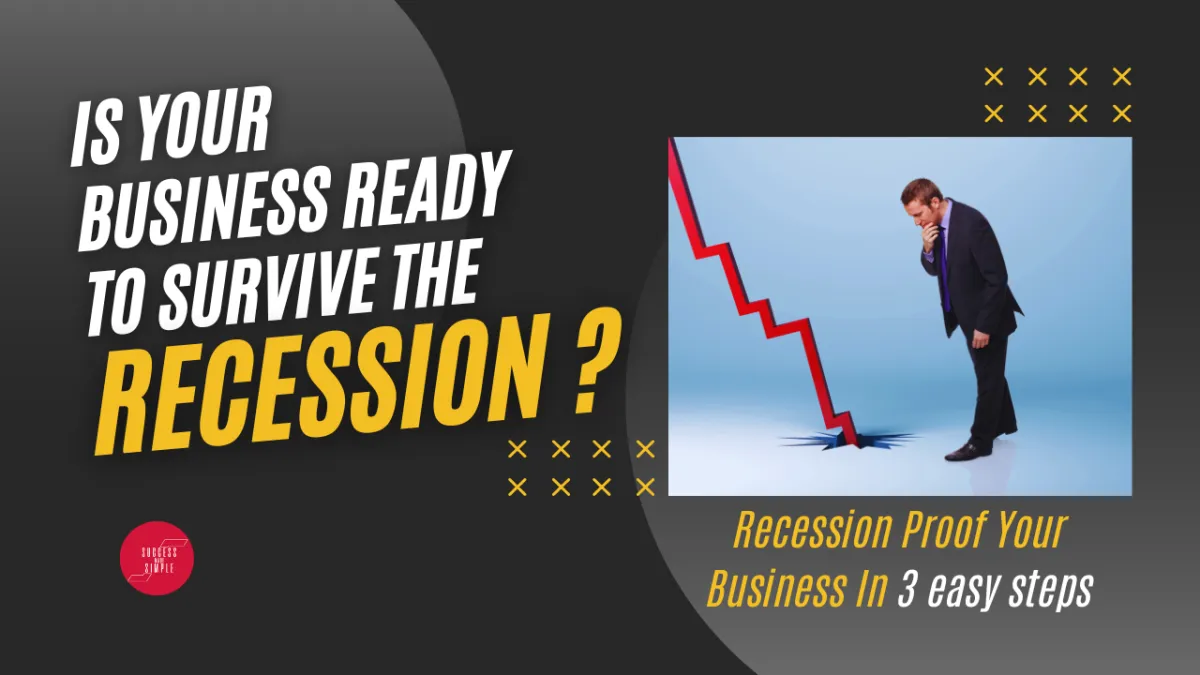
Is Your Business Ready to Survive the Recession? Find Out How to Recession Proof Your Business in Just 3 Steps!
"Recessions are scary, but if you're prepared with a plan, you can make the best of it." - Jason Lazar
Introduction:
Recessions are scary and can present tough times and challenges for businesses. If you're not prepared, they can have a significant negative impact on your bottom line. The question is, how likely are we to go into a recession?
According to the Commonwealth bank, largest lender in Australia, the country is placed at 50% odds of going into recession this year. While some may say that's a 50-50 scenario and we should wait until we get to 80%, the truth is that if you get to 80%, it's already too late.
As a business coach, it's my job and responsibility to ask the tough question, what happens to you, your employees, and your business if you go into recession this year? If you haven't sat down and thought about the likely scenarios, allow me to present some for your consideration.
The first scenario is that you're not prepared, and you don't have a plan. What will happen is that your customers will start to spend less and less on your products and services as times get tough. As a result, they no longer see your products and services as a priority, which results in a drop in demand and affects your bottom line. Banks and lenders start to get more cautious, and if you're relying on funding to scale up your business or manage your cash flow, it's going to get more and more difficult. If you're not prepared, your competition is probably going to lift their game, leaving you behind and causing you to lose market share.
On the flip side, if you're prepared and have a well-developed and thought-out plan, you can re-evaluate the operations of your business and become more efficient. There are processes that you can streamline and parts of your business that you can automate, which will help you reduce costs. You can also take proactive steps to implement cost-cutting measures, get rid of unnecessary expenses, review your supply contracts, and make serious efforts in your marketing to acquire customers. The reason you do this is that your competition is not doing it, which represents the perfect opportunity for you to increase your market share.

So, how do we recession-proof your business and make the best of this opportunity?
Here are three things that you can do right now:
1. Focus on your financial stability
Revisit all your budgets, review your pricing strategy, reduce your debt as low as you can, and where possible, find alternative arrangements to manage expenses that you can't avoid.
2. Expand on your social media presence
During the COVID lockdowns, social media platforms like Facebook, LinkedIn, and Instagram got really popular. This presents a really good advertising opportunity because it allows you to reach out to your ideal customer. It provides a channel for feedback on products and services, but more importantly, it starts to really cement that relationship that you have with your customers.
3. Focus on customer retention
When times get tough, businesses tend to invest in trying to get new customers and completely forget about the existing customer base, especially when there's an opportunity to cross-sell and upsell. I encourage you to really invest in the customer experience and nurture those relationships. Your best customer is the one you already have.
If you can focus on these three areas, I promise that when times get tough, you will find that your business works more efficiently, you're still profitable, and your market share increases because you planned ahead.
If you've made the decision to recession-proof your business but you're not sure where to start or how to start, my team and I are here to help and guide you. For a limited time, we're running a complementary business coaching session where we will sit down with you and take a very personalized approach to your business. At the end of it, we will leave you with a tangible step-by-step plan to recession-proof your business.
Don't wait until it's too late. Call +61401645723 or visit successmadesimple.com.au to book your complimentary session. I look forward to having a conversation about your business.

Baulkham Hills, NSW
+61 401 645 723